 Summer can see intense rainfall
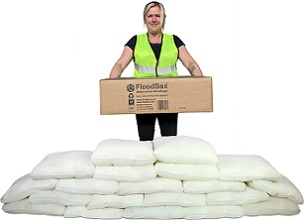 One box of 20 FloodSax can save tens of thousands of pounds of water damage
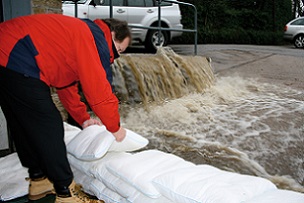 FloodSax can hold back torrential floodwater
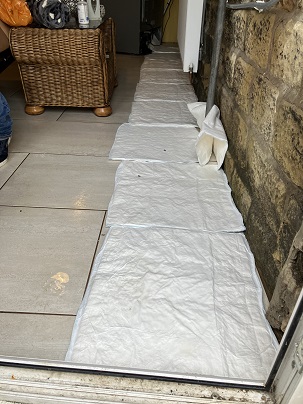 FloodSax also work inside to soak up rainwater getting in though leaky roofs and windows
Why is the rain sometimes worse in summer than winter leading to flash flooding?
People tend to associate winter with rain yet summers can be incredibly wet with a serious risk of severe flash flooding.
But why is it that summer rain can sometimes be far more devastating than winter rainfall?
According to the Met Office, one of the main reasons is that warmer air can hold more moisture.
If the air has an unlimited water supply such as an ocean – and we are usually thinking of the Atlantic here - then warmer air draws up extra moisture.
This results in clouds containing a greater number of larger rain droplets and can be why showers in summer are often heavier than in winter. As the climate continues to warm, the effect will increase and heavy rainfall events are expected to become more common, especially in the warmer summer months.
The University of Reading has looked into this in great detail and had a Flooding From Intense Rainfall (FFIR) programme which researched into flooding that is caused by more short-lived events, such as convective storms.
These are more typical during the summer period from March to September, resulting in flooding that lasts hours but impacts a much smaller area.
One of the most recent infamous examples of this was the terrible flooding in Boscastle in August 2004 which saw 75 mm of rain over 2 hours. The flooding was so severe and hard-hitting it destroyed houses and businesses.
The university also cites the summer 2007 floods that affected the whole of the UK.
The University of Reading explains: “The difficulties faced when predicting these events is that they have a much smaller scale, typically less than tens of kilometres, compared to the winter events which can have scales of hundreds to thousands of kilometres.
“The timing and location of the rainfall is particularly difficult to predict and have a big impact on how well a specific catchment can cope. Large catchments like the Thames can cope with a short intense rainfall event much more easily than a small catchment such as the River Valency which runs through Boscastle.’’
Flooding From Intense Rainfall (FFIR) is a joint Natural Environment Research Council (NERC) and Met Office funded programme supported by the Environment Agency. The programme brings together researchers from universities, the Met Office and environmental consultancies and you can read more about it here.
FloodSax are an ideal way to be prepared for flash flooding
In short, flash flooding in summer can happen anywhere at anytime and gives people virtually no time to prepare a flood defence.
This is why homeowners, businesses and public buildings need to be prepared for flooding 24 hours a day, seven days a week and 365 days a year.
One exceptionally cost-effective and efficient way is to have FloodSax alternative sandbags as they can deal with flooding and escapes of water both inside and outside – the only product in the world that is so flexible and multi-functional when it comes to preventing water damage.
In their dry state FloodSax are very flat with a large surface area so the gelling polymer can soak up escapes of water, drips, leaks and internal floods even in the most inaccessible places such as beneath floorboards as well as underneath sinks, pipes, radiators and boilers.
Once FloodSax are fully immersed in water, a gelling polymer inside absorbs and retains it to expand to become an instant sandless sandbag. Several can then be used to build a protective barrier outside to prevent water getting into the home or divert it down drains.
FloodSax were devised and are made by Environmental Defence Systems Ltd based in Huddersfield, West Yorkshire.
Company co-director Lucy Bailey said: “It’s a myth that local authorities or the Environment Agency will provide sandbags when flooding is imminent. Neither have any responsibility to do so – that responsibility is firmly with the property owner.
“Far too many times we are asked to provide FloodSax after a flood once a home or business has been flooded to prevent it happening again. Of course, by then they have had to make a massive insurance claim for water damage and many businesses struggle to reopen once they’ve been badly flooded.
“The best way is to make sure you’re prepared at all times of the day and night is a box of just 20 FloodSax costing around £140 can provide that all important peace of mind and sense of security when it comes to the continual risk of flooding and all the misery, trauma and damage that causes.’’