 Sandbags quickly fall apart
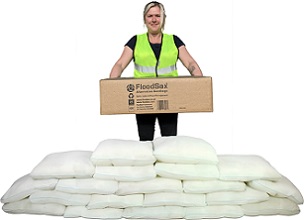 These 20 FloodSax alternative sandbags came from this one easy-to-carry box
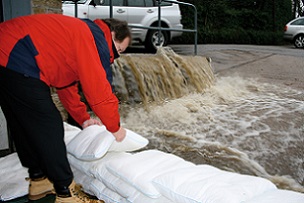 FloodSax holding back a torrent of floodwater
 FloodSax soaking up an internal leak
 Flood expert Mary Dhonau talking to a news reporter about FloodSax
Why FloodSax alternative sandbags are way cheaper than prefilled sandbags and far better for the environment too
FloodSax are way cheaper than buying pre-filled sandbags … and far better in every respect too.
The cost of buying 10 prefilled sandbags online and having them delivered is now a whopping £150 from some retailers … that’s an eye-watering £15 per sandbag.
Even at a major DIY chain in the UK it costs £115 for 10 which works out at £11.50 per bag … and you’ll need to collect them from the store yourself.
Alternatively, a box of 20 FloodSax sandless sandbags costs around £140, making it just £7 per FloodSax.
Bear in mind that old-style sandbags are one-dimensional and can only used outside to try to stop floodwater, which they do very badly.
FloodSax are multi-purpose and can be used either inside and out. They are vacuum-packed in packs of five – making them very space-saving to store - with four packs in one easy-to-carry box so can be transported anywhere quickly in a small vehicle, unlike sandbags which need pallets, lorries and lots of manpower.
In their dry state, FloodSax are ultra-flat with a large surface area which makes them ideal to soak up drips, leaks and spills indoors, especially in hard-to-reach places such as beneath boilers, below radiators and underneath pipes. They can also be popped beneath leaky roofs and windows to soak up water that’s dripping in.
To transform FloodSax into instant sandbags simply immerse them in water and the gelling polymer inside absorbs up to 20 litres of water and then retains it, making the FloodSax miraculously inflate to become an instant sandbag but without any sand.
Be warned that a lot of these old-style traditional sandbags are also way smaller than FloodSax, weighing just 15kg compared to FloodSax which are around 20kg when fully activated. FloodSax are also a uniform shape, unlike sandbags, so are far easier to stack than plastic-coated or hessian-coated sandbags to make robust barriers strong enough to stop a torrent of floodwater.
Sandbags can also quickly deteriorate, fall apart and spill sand. One sandbag company even admits on its website: “Hessian sandbags are filled to order and should be used within four weeks of purchase as they start to biodegrade as soon as they are wet.’’
You’d need at least 20 FloodSax to protect a couple of doors and airbricks for most homes but the recommendation is two boxes so you have enough to stop floodwater getting into patio doors and garages too and you’ll have some left over to deal with sudden internal escapes of water, preventing exceptionally costly and disruptive water damage.
Sandbags simply don't work
Flood experts all agree that traditional sandbags simply don’t work.
The Environment Agency states: “Sandbags are relatively ineffective when compared to purpose-built flood protection products. We strongly encourage people to use these products.”
The Environment Agency also warns that local councils have no responsibility to provide sandbags or any other flood protection, adding: “Don’t assume the authorities will provide you with sandbags in a flood emergency. It is the responsibility of property owners to take appropriate action to protect their property from flooding.”
UK flood expert Mary Dhonau, director of MDA Flood Resilience Consultants, leader of the Know Your Risk Flood Campaign and a big fan of FloodSax, says: “Sandbags do more harm than good and it frustrates and upsets me to see them continually being used as a go-to solution when they simply don’t work.
“Whenever a flood is imminent, everyone at risk calls for the inefficient and environmentally unfriendly sandbag which I consider to be no more than a ‘comfort blanket’ when a flood emergency happens.
“In a test at an accredited British Standards Institute testing tank, four sandbags placed in front of a household door failed after just 59 seconds of the water being turned on while 10 sandbags held water back for just over two minutes.
“The sand that escaped from the bag badly blocked the sump pump used to drain water out of the testing tank. This also happens in real flood conditions and sand often collects in drains afterwards, rendering them inefficient come the next heavy rainfall.”
FloodSax passed all tests under similar conditions and, as they don’t contain any sand, there’s no danger of them clogging up drains. They are also largely biodegradable by weight, making them far more environmentally friendly than traditional sandbags.
Local councils don’t like sandbags either.
Rossendale Council in Lancashire says: “Sandbags are relatively ineffective when compared to purpose-designed flood protection products. As a result, we strongly encourage people to use purpose-made flood protection products.
“Sandbags have disadvantages. During an emergency, sufficient quantities may be difficult to obtain, they are time-consuming to lay properly and can be difficult to handle, particularly for the elderly or infirm. The sacking material is biodegradable and will disintegrate if left in place for long periods of time.”
FloodSax were devised by Yorkshire-based Environmental Defence Systems Ltd and more than 3 million have now been sold worldwide.
For more information on FloodSax go to www.floodsax.co.uk